


Russian President Vladimir Putin called for better relations with the United States on Friday in a congratulatory message to President Barack Obama marking U.S. Independence Day.

Relations are at their lowest ebb in years, soured by disagreements over the conflicts in Ukraine and Syria and by differences on human rights and democracy. Both are veto-weilding members of the United Nations Security Council.
"The head of the Russian state expressed hope that ... ties between the two countries will develop successfully on the basis of pragmatism and equality despite difficulties and disagreements," the Kremlin said in a statement.
"Vladimir Putin also highlighted that Russia and the United States, as countries carrying exceptional responsibility for safeguarding international stability and security, should cooperate not only in the interests of their own nations but also the whole world," it said.

The United States has curbed its cooperation with Russia and imposed sanctions on some Russian firms and individuals over Moscow's role in Ukraine following Russia's annexation of the Crimea peninsula from Ukraine.
Washington has also threatened to impose more sanctions on Russia over what it regards as Moscow's support for a separatist rebellion in east Ukraine.
Moscow denies orchestrating the uprising and accuses Washington of trying to contain its former Cold War enemy to try to continue what Moscow regards as U.S. hegemony.
Relations are at their lowest ebb in years, soured by disagreements over the conflicts in Ukraine and Syria and by differences on human rights and democracy. Both are veto-weilding members of the United Nations Security Council.
"The head of the Russian state expressed hope that ... ties between the two countries will develop successfully on the basis of pragmatism and equality despite difficulties and disagreements," the Kremlin said in a statement.
"Vladimir Putin also highlighted that Russia and the United States, as countries carrying exceptional responsibility for safeguarding international stability and security, should cooperate not only in the interests of their own nations but also the whole world," it said.
The United States has curbed its cooperation with Russia and imposed sanctions on some Russian firms and individuals over Moscow's role in Ukraine following Russia's annexation of the Crimea peninsula from Ukraine.
Washington has also threatened to impose more sanctions on Russia over what it regards as Moscow's support for a separatist rebellion in east Ukraine.
Moscow denies orchestrating the uprising and accuses Washington of trying to contain its former Cold War enemy to try to continue what Moscow regards as U.S. hegemony.
 |
| Russian President Putin speaks during a meeting of the Presidential Council on Inter-Ethnic Relations in the Kremlin. |
If you've visited the National Museum of American History in the last century, you may have seen one of its most prized artifacts: The original star-spangled banner—the one that Americans raised at Fort McHenry to celebrate their victory over the British in the War of 1812.
It was the sight of this gigantic flag, sewn by Mary Pickersgill, that inspired Francis Scott Key to write "The Star-Spangled Banner."

And maybe you've heard about one of the biggest threats to the flag's longevity. Over the second half of the 20th century, the story goes, this national treasure's aging fabric was being infiltrated and deteriorated by tiny blue cotton microparticles—invisible-to-the-eye bits of denim that came from the jeans worn by tourists who visited the museum to admire the flag.
It's sort of romantic, this idea that little bits of blue jeans worn by the American people might be embedded in the flag itself, which is probably why so many people believed it.
"But it was never proven to be blue-jean dust," said Suzanne Thomassen-Krauss, chief conservator of the most recent Star-Spangled Banner Preservation Project. "It's been a persistent myth from the '70s. When we examined some of the fibrous debris of the flag, we did find blue cotton fibers. However, we found even more white cotton fibers, so it could have been from anything—not just blue jeans. And the amount of blue fibers compared to the white fibers was very, very low."

The flag was also covered in particles of aluminum and calcium silicate, bits of gypsum board, cement, and concrete. When it was new, the star-spangled banner—this one has 15 stars and 15 stripes—spanned 30 feet by 40 feet and weighed some 50 pounds.
The Smithsonian has had the flag since 1907, and preservation efforts, all driven by technologies of the time, have evolved dramatically over the years. In the 1960s, the Smithsonian opted to put the flag in the only Smithsonian building that was air conditioned, thinking the cool temperature would help preserve the aging flag. But in the most extensive conservation project in the flag's history, conservationists like Thomassen-Krauss found that exhibits designed to protect the flag were in fact doing the opposite.
"Negative pressure inside the building meant we were sucking inside all the construction debris and pollution from outside," Thomassen-Krauss told me. So even after museum staffers placed the flag behind a protective screen in the 1980s—the screen would drop for one minute every half-hour so visitors could catch of glimpse of Old Glory—the flag itself was essentially acting as an air filter for all the dirt and dust that floated through the building.
"If you move air and it has particulates in it and it meets a resistance, it's going to deposit the material," Thomassen-Krauss told me. "Part of it was there was an environmental system designed for that space to keep the environment more stable around the flag, but in reality, because of the negative pressure, it was creating positive pressure behind the flag—kind of making the dirt move back and forth—so there was associated soiling."
After 10 years of meticulous conservation work, the flag was put back on display in 2008—this time in a temperature controlled room with a high-tech filtration system that keeps tiny particles out.
 "We're always limited by the technology that's available," said Thomassen-Krauss. For many years, the Smithsonian couldn't build a glass case big enough for the entire flag, so only a quarter of it was on display. Today, museum staffers considered using a giant pane of glass that has an electric current running through it, so that it can be made opaque or transparent. (Ultimately, they decided not to use it.) The high-efficiency particulate air filter in the room that houses the flag today wouldn't have been available to the conservationists before Thomassen-Krauss' time. "Twenty years ago you would have only found that on vacuum cleaners designed for hazmat conditions for cleanups. That would have been a very, very expensive piece of equipment for anyone to purchase."
"We hope the current exhibit is going to last at least a generation or many generations," she said. "But if something new comes out tomorrow, we'll consider it. Every time someone says, 'I think we can do better,' we try to incorporate new things. You try and anticipate what will happen in the future, but you can never know."
U.S. grounds entire F-35 fleet pending engine inspections-
The U.S. military said it had grounded the entire fleet of 97 Lockheed Martin Corp F-35 fighter jets until completion of additional inspections of the warplane's single engine built by Pratt & Whitney, a unit of United Technologies Corp.
The Pentagon's F-35 program office, Air Force and Navy issued directives on Thursday ordering the suspension of all F-35 flights after a June 23 fire on an Air Force F-35A jet at Eglin Air Force Base in Florida.
The Pentagon said U.S. and industry officials had not pinpointed the cause of the fire, which occurred as a pilot was preparing for takeoff. The pilot was not injured.
The incident is the latest to hit the Pentagon's costliest weapons program, the $398.6 billion F-35 Joint Strike Fighter. It followed an in-flight oil leak that triggered mandatory fleetwide inspections of the jets last month.
"Additional inspections of F-35 engines have been ordered, and return to flight will be determined based on inspection results and analysis of engineering data," the Defense Department said in a brief statement issued late on Thursday.
Pratt & Whitney said it was working closely with Air Force officials who are investigating the fire and are inspecting all engines in the fleet. Spokesman Jay DeFrank said it would be inappropriate to comment further since the incident was the subject of an investigation.
The Pentagon's F-35 program office has made determining the cause of the fire its highest priority and it is assessing the impact on flight tests, training and operations of the radar-evading warplane.
A person familiar with the situation said it was premature to rule in or out any quality problem or manufacturing defect.
 Japanese Defense Minister Itsunori Onodera he wanted to discuss the F-35 problem when he visits the United States next week to tour U.S. bases and meet with Defense Secretary Chuck Hagel.
"On my coming trip to the U.S. I plan to be reviewing troops and will have a chance to discuss the F-35 development on the ground," Onodera told a regular news conference. "I’d like to confirm the details of this accident."
Japan has ordered 42 of the single-engine stealth jets that will be assembled locally by Mitsubishi Heavy Industries, maker of the World War II-era Zero fighter. Tokyo may order more F-35s when it decides the future of 100 of its older F-15s.
Australia and South Korea said there had been no change to their plans to buy the fighter jets. Australia plans to buy 58 of the fighters and South Korea intends to buy 40.
"To date the JSF aircraft has accrued 15,000 flight hours While the F135 engine has successfully completed nearly 32,000 hours of testing," a spokesman for Australia's Defense Minister David Johnston said.
"Single engine fighters are operated by many air forces and Defense remains confident the F-35 JSF will be reliable and safe."
Reuters reported on Wednesday that U.S. and British authorities were preparing directives ordering a mandatory engine inspection estimated to take about 90 minutes.
British officials remained part of the discussions with U.S. officials and concurred with the U.S. recommendation to ground the jets, pending further inspection results, the F-35 program office said.
The Pentagon said preparations were continuing for F-35 jets to participate in two UK air shows later this month, but a final decision would be made early next week. The fire has already derailed plans for an F-35 jet to fly by a naming ceremony for Britain's new aircraft carrier on Friday.
The Royal International Air Tattoo (RITA) kicks off July 11 followed by the Farnborough International Air Show starting on July 14.
 |
| Military personnel watch an F-35 Lightning II fighter jet as it taxis at Eglin Air Force Base, Florida. |
The U.S. military said it had grounded the entire fleet of 97 Lockheed Martin Corp F-35 fighter jets until completion of additional inspections of the warplane's single engine built by Pratt & Whitney, a unit of United Technologies Corp.
The Pentagon's F-35 program office, Air Force and Navy issued directives on Thursday ordering the suspension of all F-35 flights after a June 23 fire on an Air Force F-35A jet at Eglin Air Force Base in Florida.
The Pentagon said U.S. and industry officials had not pinpointed the cause of the fire, which occurred as a pilot was preparing for takeoff. The pilot was not injured.
The incident is the latest to hit the Pentagon's costliest weapons program, the $398.6 billion F-35 Joint Strike Fighter. It followed an in-flight oil leak that triggered mandatory fleetwide inspections of the jets last month.
"Additional inspections of F-35 engines have been ordered, and return to flight will be determined based on inspection results and analysis of engineering data," the Defense Department said in a brief statement issued late on Thursday.
Pratt & Whitney said it was working closely with Air Force officials who are investigating the fire and are inspecting all engines in the fleet. Spokesman Jay DeFrank said it would be inappropriate to comment further since the incident was the subject of an investigation.
The Pentagon's F-35 program office has made determining the cause of the fire its highest priority and it is assessing the impact on flight tests, training and operations of the radar-evading warplane.
A person familiar with the situation said it was premature to rule in or out any quality problem or manufacturing defect.
Japanese Defense Minister Itsunori Onodera he wanted to discuss the F-35 problem when he visits the United States next week to tour U.S. bases and meet with Defense Secretary Chuck Hagel."On my coming trip to the U.S. I plan to be reviewing troops and will have a chance to discuss the F-35 development on the ground," Onodera told a regular news conference. "I’d like to confirm the details of this accident."
Japan has ordered 42 of the single-engine stealth jets that will be assembled locally by Mitsubishi Heavy Industries, maker of the World War II-era Zero fighter. Tokyo may order more F-35s when it decides the future of 100 of its older F-15s.
Australia and South Korea said there had been no change to their plans to buy the fighter jets. Australia plans to buy 58 of the fighters and South Korea intends to buy 40.
"To date the JSF aircraft has accrued 15,000 flight hours While the F135 engine has successfully completed nearly 32,000 hours of testing," a spokesman for Australia's Defense Minister David Johnston said.
"Single engine fighters are operated by many air forces and Defense remains confident the F-35 JSF will be reliable and safe."
Reuters reported on Wednesday that U.S. and British authorities were preparing directives ordering a mandatory engine inspection estimated to take about 90 minutes.
British officials remained part of the discussions with U.S. officials and concurred with the U.S. recommendation to ground the jets, pending further inspection results, the F-35 program office said.
The Pentagon said preparations were continuing for F-35 jets to participate in two UK air shows later this month, but a final decision would be made early next week. The fire has already derailed plans for an F-35 jet to fly by a naming ceremony for Britain's new aircraft carrier on Friday.
The Royal International Air Tattoo (RITA) kicks off July 11 followed by the Farnborough International Air Show starting on July 14.
One person was killed and three others severely injured when a truck trailer carrying fireworks for a Fourth of July celebration at a central Texas high school exploded on Thursday as workers prepared the show, a fire official said.
The person who was killed had experience handling fireworks and was licensed, said Marcus Nettleton of the Comanche Volunteer Fire Department. The victim was not immediately identified.
The injured were local residents who were setting up the Fourth of July fireworks display at the Comanche High School football stadium.

Crews were unloading tubes containing fireworks from the trailer when it exploded, setting two vehicles on fire, Nettleton said.
The state's fire marshal and the federal Bureau of Alcohol, Tobacco, Firearms and Explosives were investigating the cause of the accident.The fireworks display at the school, about 120 miles (200 km) southwest of Dallas, was canceled, local officials said.
 |
| This photo from video provided by WFAA-TV in Dallas shows the aftermath of a fireworks explosion in Comanche, Texas, Thursday, July 3, 2014. |
The person who was killed had experience handling fireworks and was licensed, said Marcus Nettleton of the Comanche Volunteer Fire Department. The victim was not immediately identified.
The injured were local residents who were setting up the Fourth of July fireworks display at the Comanche High School football stadium.
Crews were unloading tubes containing fireworks from the trailer when it exploded, setting two vehicles on fire, Nettleton said.
The state's fire marshal and the federal Bureau of Alcohol, Tobacco, Firearms and Explosives were investigating the cause of the accident.The fireworks display at the school, about 120 miles (200 km) southwest of Dallas, was canceled, local officials said.
 |
| Raw video from Chopper 5 shows the scene of a fireworks accident that left one person dead and four injured in Comanche, Texas on July 3, 2014. |
Is there a typo in founding document?
There's a heated scholarly debate about a curious period that may or may not extend our rights beyond "the pursuit of happiness."
 |
| The portion of the Declaration of Independence in question. |
First, let's pinpoint what's in question here. The official transcription from the National Archives reads (emphasis ours):
"We hold these truths to be self-evident, that all men are created equal, that they are endowed by their Creator with certain unalienable Rights, that among these are Life, Liberty and the pursuit of Happiness."
See that period? According to Princeton professor Danielle Allen, it's not actually in the original document. If she's right, then the individual rights of "Life, Liberty, and the pursuit of Happiness" would share a sentence with what follows:
"— That to secure these rights, Governments are instituted among Men, deriving their just powers from the consent of the governed, --That whenever any Form of Government becomes destructive of these ends, it is the Right of the People to alter or to abolish it, and to institute new Government, laying its foundation on such principles and organizing its powers in such form, as to them shall seem most likely to effect their Safety and Happiness."
Allen, speaking to the Times, argues that Thomas Jefferson intended to emphasize the second part of this passage — the role of the government — equally with the individual rights in the first part. Instead, with the period in place, there's an implied hierarchy. So you can begin to see how one little punctuation mark's presence or absence could become the subject of heated debate among those who have strong opinions about the role of government as it concerns individual liberty. Although the punctuation mark is still very much up for debate among experts, Allen has convinced several scholars that she might be on to something. The National Archives told the Times that they "want to take advantage of this possible new discovery" and find a way to re-examine the incredibly fragile original Declaration of Independence.
And that brings us to why it's so difficult to get to the bottom of this question. The handful of facsimiles that are considered early, authoritative copies of the original document differ on the presence of the period, although Allen argues that the bulk of those early copies — including the "Rough Draft" of the document — support her conclusions. So the original document could be the only thing that could put this line of questioning to rest. But the 1776 original, stored in a complex preservation system along with the Bill of Rights and the Constitution, is in really, really bad shape. It's more or less illegible. The National Archive will try to use new imaging technology to get a clearer picture of the mark in question, but it's not guaranteed to be conclusive.
If it does turn out that Allen is right, however, it would hardly be the first time a founding document has contained an error or a revision. The Constitution is basically full of small errors, for instance. And in 2010, the Library of Congress announced that it had discovered evidence of a big correction Jefferson himself made to the rough draft of the Declaration: Jefferson initially wrote the word "subjects" at one point, but later smudged out the word and wrote a different one in its place: "citizens."
 |
| In this handout provided by NASA from the the Earth-orbiting International Space Station, weather system Arthur travels up the East Coast of the United States in the Atlantic Ocean near Florida on July 2, 2014 in space. |
Hurricane Arthur gained strength in the Atlantic on Thursday and threatened to strike near the North Carolina coast on Independence Day, prompting thousands of vacationers and residents to leave parts of the state's popular but flood-prone Outer Banks.
Nichole Specht, 27, and Ryan Witman, 28, had pre-loaded their Honda CRV and left Hatteras Island at 3:30 a.m. Thursday, beating the expected traffic jam. The island was under an evacuation order, with no traffic allowed in. Officials asked an estimated 35,000 residents and travelers to leave through North Carolina Highway 12, the only road on and off Hatteras.
Specht and Witman found the road wide open for their return home to Lancaster, Pennsylvania. Specht said her parents left their rental later, at 5 a.m., and also found clear sailing.
Check your local forecast
"We were just saying we were really, really lucky this year that the weather was so great, and then this," Specht said as she ended a two-week vacation that included scouting sites for the couple's wedding next year.
Forecasters expect Arthur to speed up to a Category 2 storm and pass over or near the Outer Banks — a 200-mile string of narrow barrier islands with about 57,000 permanent residents — early Friday, bringing rain, heavy winds, storm surge and dangerous rip currents. Category 2 hurricanes pack winds of more than 96 mph.
Before the storm hit, tourism officials had expected 250,000 people to travel to the Outer Banks for the holiday weekend. Gov. Pat McCrory sought to strike a balance between a stern warning to vacationers and optimism that part of the busy weekend could be salvaged.
On Wednesday, he warned people: "Don't put your stupid hat on."
But the next day, even as the storm gathered strength, he said: "Of course, this holiday weekend, the July 4th weekend, is one of the biggest weekends for coastal tourism in the state, and we anticipate a beautiful weekend after the Tropical Storm Arthur or the Hurricane Arthur is out of North Carolina."

Some visitors stayed put, hopeful the fast-moving storm would follow predictions to pass through by Friday afternoon. About 20 miles north of the only bridge off Hatteras, Sean Fitzgerald and his 5-year-old son, Cade, enjoyed a sunny morning lounging in beach chairs in the town of Kill Devil Hills.
The sand was dotted with tourists. A handful of surfers took to the water. Like all areas north of Oregon Inlet, Kill Devils Hills wasn't under an evacuation. Fitzgerald said he saw no need to disrupt his family's vacation.
"I plan to sit on the beach as long as the sun is here," then head out for a seafood dinner, said Fitzgerald, 44, of Fairfax, Virginia.
Those who don't evacuate the islands should prepare for possibly getting stuck for several days without food, water or power, National Hurricane Center forecaster Stacy Stewart said Thursday.
"We want the public to take this system very seriously, go ahead and start their preparations because time is beginning to run out," he said.
Arthur, the first named storm of the Atlantic season, prompted a hurricane warning for much of the North Carolina coast. Tropical storm warnings were in effect for coastal areas in South Carolina and Virginia. On the Outer Banks' Ocracoke Island, accessible only by ferry, a voluntary evacuation was underway. Officials said ferry service would end at 5 p.m.
Before sunset Wednesday on Highway 12, a long line of cars, trailers and recreational vehicles formed a steady stream of traffic. The road has been sliced apart twice in recent years as storms cut temporary channels from the ocean to the sound. N.C. 12 is easily blocked by sand and water.
Officials called the evacuation for Hatteras Island residents and visitors mandatory, but some residents were likely to stay, as in past storms.
Mike Rabe of Virginia Beach, Virginia, planned to remain in his Outer Banks beach home the entire weekend. He and his wife, Jan, stowed lawn furniture and anything else that could be tossed about by winds, then planned to help a neighbor.
"I'm going to ride it out," Rabe, 53, said.
The holiday weekend was not expected to be a complete loss on the Outer Banks. Forecasters said the storm would move through quickly with the worst of the weather near Cape Hatteras about dawn Friday. Then it was expected to clear. The National Hurricane Center predicted Arthur would start to weaken Friday night.
Farther north, the annual Boston Pops Fourth of July concert and fireworks show was moved up a day because of potential heavy rain ahead of Hurricane Arthur. Organizers and public safety officials said the celebration was rescheduled for Thursday, which appeared to be the best of two potential bad weather days. Other cities along the East Coast warned of weather condition and potentially life-threatening rip currents.
Late Thursday morning, Arthur was about 260 miles (415 kilometers) southwest of Cape Hatteras and moving north around 14 mph (22 kph) with maximum sustained winds of 90 mph (150 kph).
If Arthur makes landfall in the U.S. on Friday, it would be the first hurricane to do so on July Fourth, according to National Hurricane Center research that goes back to the 1850s.
 |
| This photo provided by Roberto Danino shows emergency personnel near a section of the facade inside an underpass of the Brooklyn Bridge after it had collapsed, Wednesday, July 2, 2014, in the Brooklyn borough of New York. |
Authorities say a section of the facade inside an underpass of the Brooklyn Bridge has collapsed, injuring five people.
It happened just before 8 p.m. Wednesday in Brooklyn during a passing thunder shower.
A fire department spokesman says the collapse involved a roughly 25-foot wide section of the facade.
 All of the injuries were minor. It wasn't immediately known who was hurt.
Department of Buildings inspectors are investigating.
There is no word on what caused the collapse.
Residents of a Southern California town confronted their mayor on Wednesday over the arrival of Central American migrants for processing after they slipped across the Mexico border into Texas, extending an influx that has swamped authorities there.
Families and unaccompanied minors have been fleeing strife-torn Guatemala, El Salvador and Honduras and streaming by the thousands over the U.S.-Mexico frontier with the help of human smuggling rings.
Most have shown up in Texas, swamping detention and reception centers there and leading U.S. immigration authorities to set up overflow sites in California and other states in the Southwest to help screen and manage the influx.
Dozens more migrants were shipped to California for processing on Wednesday, a day after protesters blocked buses full of Central American families bound for a Border Patrol station north of San Diego.
Later on Wednesday at least 1,000 residents of Murrieta near San Diego crammed into a town hall meeting to protest over hundreds of migrants the federal government aims to provisionally accommodate in the San Diego suburb.
Protesters on Tuesday had blocked three buses carrying the first group of 140 migrants headed to Murrieta, forcing the caravan to turn around and head to another Border Patrol station in San Diego for processing there instead.
U.S. Homeland Security Secretary Jeh Johnson, in an interview with MSNBC, said he found television images of that demonstration "very disturbing" to watch.
"Because of the recent influx of kids and families crossing the border in the Rio Grande sector, our processing capability (there) is full and we've had to go to other places in the Southwest simply to process these people," Johnson said.
"So when someone interrupts the ability of the border patrol to process a migrant, you're preventing us from conducting basic health screening and the basic background checks on who these people are," he said.
'SEND WASHINGTON A BILL'
Immigration officials said most of the families headed for California were likely to be released under limited supervision to await deportation. Many would to be placed with relatives or friends or in temporary housing provided by charity groups.
On Wednesday, border protection officials confirmed that a separate group of undocumented migrant families with children were sent to a processing center in El Centro, California, a desert community about 100 miles (160 km) east of San Diego.
Immigration and Customs Enforcement agency spokeswoman Virginia Kice said authorities were being especially careful to avoid disclosing the whereabouts of the detainees "so that mobs can't go down and root out those people".
At the town hall meeting in Murrieta, Mayor Alan Long told the angry throng that he had been advised by U.S. officials to expect another group of about 140 immigrants every three days for several weeks.
He blamed federal officials for the influx, saying that he intended to "send Washington a big fat bill" for expenses.
Residents filled the meeting hall to capacity and spilled out into a parking lot, carrying signs with slogans like "Illegals today, Jihadists with Nukes tomorrow!!".
A man scuffled with police after they stopped him walking into the meeting draped with a flag. The meeting adjourned at about 11 p.m. local time and residents left without incident.
 |
| Residents and protestors attend a town hall meeting to discuss the processing of undocumented immigrants in Murrieta, California. |
Most have shown up in Texas, swamping detention and reception centers there and leading U.S. immigration authorities to set up overflow sites in California and other states in the Southwest to help screen and manage the influx.
Dozens more migrants were shipped to California for processing on Wednesday, a day after protesters blocked buses full of Central American families bound for a Border Patrol station north of San Diego.
Later on Wednesday at least 1,000 residents of Murrieta near San Diego crammed into a town hall meeting to protest over hundreds of migrants the federal government aims to provisionally accommodate in the San Diego suburb.
Protesters on Tuesday had blocked three buses carrying the first group of 140 migrants headed to Murrieta, forcing the caravan to turn around and head to another Border Patrol station in San Diego for processing there instead.
U.S. Homeland Security Secretary Jeh Johnson, in an interview with MSNBC, said he found television images of that demonstration "very disturbing" to watch.
"Because of the recent influx of kids and families crossing the border in the Rio Grande sector, our processing capability (there) is full and we've had to go to other places in the Southwest simply to process these people," Johnson said.
"So when someone interrupts the ability of the border patrol to process a migrant, you're preventing us from conducting basic health screening and the basic background checks on who these people are," he said.
'SEND WASHINGTON A BILL'
Immigration officials said most of the families headed for California were likely to be released under limited supervision to await deportation. Many would to be placed with relatives or friends or in temporary housing provided by charity groups.
On Wednesday, border protection officials confirmed that a separate group of undocumented migrant families with children were sent to a processing center in El Centro, California, a desert community about 100 miles (160 km) east of San Diego.
Immigration and Customs Enforcement agency spokeswoman Virginia Kice said authorities were being especially careful to avoid disclosing the whereabouts of the detainees "so that mobs can't go down and root out those people".
At the town hall meeting in Murrieta, Mayor Alan Long told the angry throng that he had been advised by U.S. officials to expect another group of about 140 immigrants every three days for several weeks.
He blamed federal officials for the influx, saying that he intended to "send Washington a big fat bill" for expenses.
Residents filled the meeting hall to capacity and spilled out into a parking lot, carrying signs with slogans like "Illegals today, Jihadists with Nukes tomorrow!!".
A man scuffled with police after they stopped him walking into the meeting draped with a flag. The meeting adjourned at about 11 p.m. local time and residents left without incident.
The Obama administration is pushing for increased security precautions at European airports because of concerns that al Qaeda operatives in Syria and Yemen have teamed up to develop bombs that can be smuggled onto planes, U.S. officials said on Wednesday.
Bombmakers from the Nusra Front, al Qaeda's affiliate in Syria, and Yemen-based Al Qaeda in the Arabian Peninsula (AQAP) are believed to be working together to try to develop explosives that could avoid detection by current airport screening systems, U.S. national security sources said.
The main concern is that militant groups could try to blow up U.S. or Europe-bound planes by concealing bombs on foreign fighters carrying Western passports who spent time with Islamist rebel factions in the region, the sources said.
AQAP already has a track record for plotting such attacks. It was behind a failed 2009 attempt by a militant with a bomb hidden in his underwear to blow up a Detroit-bound airliner.
U.S. officials believe Nusra and AQAP operatives have carried out operational testing of new bomb designs in Syria, where Nusra is one of the main Islamist groups fighting to overthrow President Bashar al-Assad, a national security source said.
The "stealth" explosives the bombmakers are trying to design include non-metallic bombs, ABC News reported.
There was no immediate indication that U.S. intelligence has detected a specific plot or timeframe for carrying out such an attack.
But officials are especially worried that the recent battlefield successes of the Islamic State in Iraq and the Levant (ISIL), an al Qaeda splinter group, have drawn a growing number of militants from America and Europe to the jihadist cause and they would have easy access to flights headed for U.S. cities.
Still, the Obama administration has been cautious in its response.
Negotiations for beefed-up security with European governments have taken place behind the scenes, apparently to avoid raising alarm among air travelers and to minimize diplomatic fallout. U.S. officials said some measures under discussion will remain secret.
 |
| Travelers pass through airport security for a flight to Heathrow airport in Britain, at Otopeni international airport near Bucharest January 1, 2014. |
The U.S. government is in discussions with European authorities on measures that could include extra scrutiny of U.S.-bound passengers' electronics and footwear, and installation of additional bomb-detection machines, according to law-enforcement and security officials. An announcement is expected within days.
Bombmakers from the Nusra Front, al Qaeda's affiliate in Syria, and Yemen-based Al Qaeda in the Arabian Peninsula (AQAP) are believed to be working together to try to develop explosives that could avoid detection by current airport screening systems, U.S. national security sources said.
The main concern is that militant groups could try to blow up U.S. or Europe-bound planes by concealing bombs on foreign fighters carrying Western passports who spent time with Islamist rebel factions in the region, the sources said.
AQAP already has a track record for plotting such attacks. It was behind a failed 2009 attempt by a militant with a bomb hidden in his underwear to blow up a Detroit-bound airliner.
U.S. officials believe Nusra and AQAP operatives have carried out operational testing of new bomb designs in Syria, where Nusra is one of the main Islamist groups fighting to overthrow President Bashar al-Assad, a national security source said.
The "stealth" explosives the bombmakers are trying to design include non-metallic bombs, ABC News reported.
There was no immediate indication that U.S. intelligence has detected a specific plot or timeframe for carrying out such an attack.
But officials are especially worried that the recent battlefield successes of the Islamic State in Iraq and the Levant (ISIL), an al Qaeda splinter group, have drawn a growing number of militants from America and Europe to the jihadist cause and they would have easy access to flights headed for U.S. cities.
Still, the Obama administration has been cautious in its response.
Negotiations for beefed-up security with European governments have taken place behind the scenes, apparently to avoid raising alarm among air travelers and to minimize diplomatic fallout. U.S. officials said some measures under discussion will remain secret.
A federal judge on Wednesday directed a Libyan militant charged in the 2012 Benghazi attacks to remain in U.S. custody after his own lawyer conceded that he had no reasonable chance of being released.
But she said she had so far seen no evidence of any role by Khattala in the Sept. 11, 2012 attacks that killed the U.S. ambassador to Libya and three other Americans.
"What's been filed has shown, quite frankly, an utter lack of evidence of Mr. Khattala's involvement in the incident in Benghazi," said Michelle Peterson, an assistant federal public defender, adding, "We are left to glean from press reports what the government's evidence is."
Prosecutors provided some new details in a court filing Tuesday night, arguing that he was part of a group of roughly 20 militants who stormed the diplomatic compound on the night of the attacks. They say he was motivated to participate in the attacks by an extremist ideology.
Abu Khattala appeared briefly in federal court in Washington, wearing a green prison jumpsuit and a long, graying beard. He listened to the proceedings through headphones as an interpreter translated the conversation into Arabic. Peterson requested that he be served a halal diet and be provided with a copy of the Quran.
Abu Khattala was captured in Libya more than two weeks ago and then brought to the United States aboard a Navy ship, where he was interrogated by federal agents. He has pleaded not guilty to a charge of conspiring to provide support to terrorists — a crime punishable by up to life in prison — but the Justice Department has said it expects additional charges soon.
 |
| US Marshals patrol the area outside federal court in Washington, Wednesday, July 2, 2014, where Libyan militant Ahmed Abu Khattala, charged in the deadly attack at the U.S. diplomatic outpost in Benghazi, is being held for a detention hearing. |
A lawyer for Ahmed Abu Khattala acknowledged that it was appropriate for her client to remain behind bars at the moment, given the nature of the charge he faces and his lack of ties to the United States.
But she said she had so far seen no evidence of any role by Khattala in the Sept. 11, 2012 attacks that killed the U.S. ambassador to Libya and three other Americans.
"What's been filed has shown, quite frankly, an utter lack of evidence of Mr. Khattala's involvement in the incident in Benghazi," said Michelle Peterson, an assistant federal public defender, adding, "We are left to glean from press reports what the government's evidence is."
Prosecutors provided some new details in a court filing Tuesday night, arguing that he was part of a group of roughly 20 militants who stormed the diplomatic compound on the night of the attacks. They say he was motivated to participate in the attacks by an extremist ideology.
Abu Khattala appeared briefly in federal court in Washington, wearing a green prison jumpsuit and a long, graying beard. He listened to the proceedings through headphones as an interpreter translated the conversation into Arabic. Peterson requested that he be served a halal diet and be provided with a copy of the Quran.
Abu Khattala was captured in Libya more than two weeks ago and then brought to the United States aboard a Navy ship, where he was interrogated by federal agents. He has pleaded not guilty to a charge of conspiring to provide support to terrorists — a crime punishable by up to life in prison — but the Justice Department has said it expects additional charges soon.
Matthew Coniglio's Georgia home held a trove of child pornography, more than 50,000 images and videos stored on laptops, external hard drives and thumb drives.

Among the stash, hidden in a bedside table turned around to conceal the doors, authorities made an even more horrifying discovery: 56 8-millimeter cassette tapes they say show him raping and molesting girls.
 All were unconscious, apparently drugged, FBI Special Agent William Kirkconnell, who viewed the tapes, told The Associated Press. Some were so incapacitated they were snoring. The camera was always turned off before they awoke.
Many of the victims' faces cannot be clearly identified, so investigators don't know how many different girls were attacked. But each tape recorded at least one assault — some had more — in homes and hotels. The youngest victim appears to be about 10 years old.
As for the alleged perpetrator, a 46-year-old traveling salesman who worked and lived in cities across Georgia, South Carolina and North Carolina, "he often looks back at the camera and even speaks," Kirkconnell said. "There's no doubt it's Matthew Coniglio. None at all."
Who were these girls, and do they know what happened to them?
Could there be other victims?
The FBI shared exclusive details of the case with AP in the hope that victims will step forward and can be offered help and counseling. The AP also uncovered other exclusive details of Coniglio's past and his previous encounters with the law.
Authorities' best chance for resolving the raft of unanswered questions vanished on April 20. Ten days after his arrest, Coniglio wrote goodbye letters to his parents, tied a cord to a vent above a sink in his jail cell and hanged himself in an apparent suicide.
 ___
___Nearly a decade before his arrest, Coniglio sat in a South Carolina deputy sheriff's office and was asked point-blank if he was a pedophile.

"He said that he was not," Deputy Angela Olds wrote in her 2005 investigation into an incident involving Coniglio, according to records obtained by the AP.
At the time, Coniglio worked selling food products in Hilton Head, and at one diner he told an employee that he and a partner had started a modeling agency. He asked to take pictures of the woman's 11-year-old daughter at a mall. The girls' parents agreed. The AP is withholding the family's name because it does not generally identify possible victims of sexual abuse.
The girl and her father met Coniglio in the diner parking lot, the father told deputies. After the father agreed to meet them at the mall, the girl left in Coniglio's car. Records show Coniglio took her to a hotel room rigged with video cameras and offered her a soda. He asked her to flop down on a bed.
The girl, when questioned by authorities, never said she was assaulted but said she felt uncomfortable at the hotel and demanded that Coniglio take her home. At some point he did. She also said she thought she was at the hotel for no more than an hour, while her parents said she was missing for several hours.
In the deputy's report, the mother said that her daughter came home very upset and locked herself in her bedroom closet, prompting the mother to call authorities.
During a voluntary interview with deputies, Coniglio said the girl was the first he tried to photograph for his fledgling business. He denied taking any pictures, and said he had apologized to the girl's mother "because he knows that it looks bad," Olds wrote. He denied he was aroused by children, Olds wrote in her report. Now a master sergeant at the Beaufort County Sheriff's Office, Olds, who now uses the last name Viens, declined an interview.
Coniglio was never charged.
 ___
___He grew up in a suburban home in Kingwood, Texas, with his mom, dad and sister, Coniglio's mother, Betty Coniglio, told the AP. He wanted to be a writer, penning poetry and plays. But after college, Coniglio followed his father into the food distribution industry.
Betty Coniglio described her son as outgoing, and she remembered friends calling him at all hours for advice or solace. She added that she does not believe her son was guilty.
"I guess if this was true he was leading a double life," she said.
There were problems, however. After his arrest this year, Coniglio told a jailhouse nurse that he drank heavily — up to 13 beers and cocktails daily, records show. And he had at least two prior arrests related to alcohol, most recently for driving drunk in 2000.
The videos suggest the attacks on the girls started around the time of the 2000 arrest or earlier, investigators said. It wasn't until March, however, that a police officer in Pooler, Georgia, where Coniglio lived, identified him as a suspect in an online child pornography case. Investigators got a search warrant, and found the tapes.
Charged with possessing child pornography, Coniglio hadn't entered a plea before he died. Kirkconnell said authorities planned to bring federal charges but never got the chance.
Coniglio's lawyer, Tom Edenfield, declined to comment.
Former FBI Assistant Director Ronald Hosko said it is not uncommon for molesters to have multiple victims. They are skilled at developing trust, and adept at appearing otherwise law-abiding and safe.
"To think you know by looking at somebody — chances are you're way off the mark," Hosko said.
In March, a former teacher at international schools on four continents, William Vahey, killed himself after he was accused of molesting potentially 90 or more boys. He allegedly drugged them with Oreos laced with sleeping pills.
Coniglio's death could make it impossible for authorities to find his victims and learn the scale of his alleged crimes.
Investigators believe he killed himself while alone at the Chatham County jail in Savannah, Georgia, and that he may have plotted the attempt for days. His cellmate told investigators Coniglio had asked for an hour of privacy in their cell in the evenings, right after guards usually finished a round of checks. A jail guard resigned after he was accused of failing to perform required cell checks around the time Coniglio died.
As part of its effort to find victims, the FBI created a confidential online questionnaire that victims or others with information can fill out to be contacted by investigators.
So far, only a single victim has been identified.
Her mother, a friend of Coniglio's when he lived in Charleston, South Carolina, allowed the girl to spend unsupervised time with him. The mother saw a news report about Coniglio and brought her daughter to investigators along with old photos of her.
"She recalls that he would always give her ice cream and give her hot chocolate, and she recalled that ... those items at times tasted very bitter to her," said Kirkconnell, who believes Coniglio drugged the treats to knock her out.
In letters he wrote to his parents before his death and obtained by the AP under open records laws, Coniglio did not explicitly discuss the case, but he said "a lot" of the allegations leveled against him were untrue and exaggerated. He also acknowledged he had "let sin pull me where it wanted."
He called himself a "troubled soul" who had wrestled with alcoholism and depression for years. And he apologized for the pain he caused his family.
"The decision I'm making tonight is the most difficult one I've ever had to make," he wrote. But it would be, he said, "the best way out for all."
But authorities' best chance for resolving the unanswered questions vanished April 20 —when Coniglio hanged himself in an apparent suicide inside a Georgia jail before his trial could start.
The FBI hopes to identify potential victims of a traveling salesman accused of videotaping himself raping girls.

Matthew Coniglio, 46, was arrested April 10 at his Georgia home on a child pornography charge.

The FBI said investigators found 56 8-millimeter tapes showing Coniglio attacking girls who may have been drugged into unconsciousness.
 Many of the victims' faces cannot be clearly identified, so investigators don't know how many different girls were attacked. But each tape recorded at least one assault — some had more — in homes and hotels. The youngest victim appears to be about 10 years old. Coniglio worked and lived in cities across Georgia, South Carolina and North Carolina.
The FBI shared exclusive details of the case with The Associated Press in the hope victims will step forward and can be offered counseling.
But authorities' best chance for resolving the unanswered questions vanished April 20 — when Coniglio hanged himself in an apparent suicide inside a Georgia jail before his trial could start.
A bus carrying migrant families was on the move once again early Wednesday, hours after being blocked by flag-toting protesters in Murrieta, California.
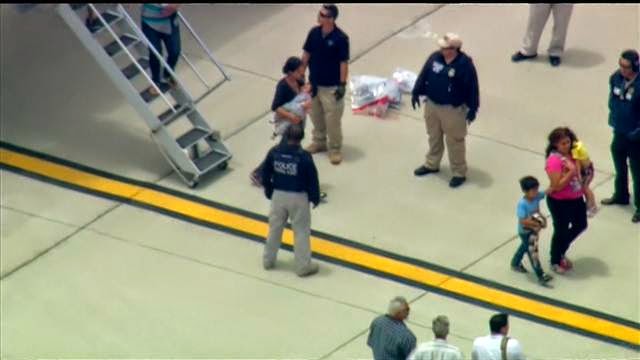 The immigrants - mainly children and their families who had fled violence in Central America - arrived in the San Diego area on three buses Tuesday after being transferred from a facility in Texas.
Residents and city leaders in Murrieta, including Mayor Alan Long, oppose the transfers, saying they are burdens on the town.
"This is a failure to enforce federal law at a federal level,” Long said in a statement posted on his Facebook page.

The buses were eventually rerouted to a border facility at San Ysidro where they were held into the early hours of Wednesday.
At least one of the buses left San Ysidro at 1.30 a.m. local time (4.30 a.m ET) for an unknown destination, NBC Los Angeles reported.
Activists chanted in support of the undocumented families outside the border post. “As a country we’re better than that," one supporter told NBC Los Angeles.
Residents and city leaders in Murrieta, including Mayor Alan Long, oppose the transfers, saying they are burdens on the town.
"This is a failure to enforce federal law at a federal level,” Long said in a statement posted on his Facebook page.
The buses were eventually rerouted to a border facility at San Ysidro where they were held into the early hours of Wednesday.
 |
| protestors in Murrieta, CA |
At least one of the buses left San Ysidro at 1.30 a.m. local time (4.30 a.m ET) for an unknown destination, NBC Los Angeles reported.
Activists chanted in support of the undocumented families outside the border post. “As a country we’re better than that," one supporter told NBC Los Angeles.
 |
Busses carrying Texas detainees turned away by protesters in Murrieta.. dramatic video |
Michelle Howard on Tuesday became the first woman to reach the rank of four-star admiral in the U.S. Navy, part of a trailblazing path in the armed forces.
Howard, 54, was sworn in at a ceremony overseen by Navy Secretary Ray Mabus, the Pentagon said in a statement. With her promotion, she became the 38th vice chief of naval operations.
"Her accomplishment is a direct example of a Navy that now, more than ever, reflects the nation it serves - a nation where success is not born of race, gender or religion, but of skill and ability," Mabus said.
Howard graduated from high school in Aurora, Colorado, and was one of the first women to attend the U.S. Naval Academy. She holds a master's degree from the Army's Command and General Staff College.
Howard took command of the USS Rushmore, a dock landing ship, in 1999. She was the first African-American woman to command a ship in the U.S. Navy, and is the first female vice chief of naval operations.
In 2009, she commanded a multinational anti-piracy task force in the Indian Ocean. Howard was the Maritime Task Force commander for Baltic operations in 2010 as part of the 6th Fleet.
 |
Secretary of the Navy Ray Mabus, left, and Wayne Cowles, husband of Adm. Michelle Howard, put four-star shoulder boards on Howard's service white uniform during her promotion ceremony at the Women in Military Service for America Memorial July 1, 2014 in Washington. |
"Her accomplishment is a direct example of a Navy that now, more than ever, reflects the nation it serves - a nation where success is not born of race, gender or religion, but of skill and ability," Mabus said.
Howard graduated from high school in Aurora, Colorado, and was one of the first women to attend the U.S. Naval Academy. She holds a master's degree from the Army's Command and General Staff College.
Howard took command of the USS Rushmore, a dock landing ship, in 1999. She was the first African-American woman to command a ship in the U.S. Navy, and is the first female vice chief of naval operations.
In 2009, she commanded a multinational anti-piracy task force in the Indian Ocean. Howard was the Maritime Task Force commander for Baltic operations in 2010 as part of the 6th Fleet.
Some 140 illegal immigrants, many of them women with children, will be flown from Texas to California and processed through a San Diego-area U.S. Border Patrol station as federal officials deal with a crush of Central American migrants at the border, a local mayor said on Monday.
Murrieta Mayor Alan Long, whose community of 107,000 people is 60 miles (97 km) north of San Diego, said at a news conference that he was told by federal officials the immigrants will arrive on Tuesday and many will be released to live with friends or relatives in the United States.
U.S. Immigration and Customs Enforcement (ICE) in a statement confirmed migrants would be moved from Texas to U.S. Border Patrol stations in Southern California, but they declined to say how many would arrive. Some will be released and told to report within 15 days to an ICE office, as part of deportation proceedings, the statement said.
"Clearly this is a failure to enforce federal law, and it's spreading the cost and needed resources to handle these situations back on the backs of the local communities," Long said at a news conference.
Starting on Tuesday, about 140 migrants are expected to be processed through the U.S. Border Patrol station in Murrieta every 72 hours for a number of weeks, he said.
The immigrant families coming to Southern California are part of a large influx of Central Americans, many of them children, who have crossed into the Rio Grande Valley of Texas and outstripped the ability of federal immigration and border agencies to hold them, officials said.
In May, federal officials disclosed they were releasing hundreds of immigrants at bus stations in Phoenix and Tucson with an order to report to an ICE office in 15 days. That action has been sharply criticized by the state's governor and attorney general.
A number of Republican elected officials have said President Barack Obama was failing to secure the border and should more quickly deport migrants from Central America. The controversy came as some U.S. groups pushed for policy reform to let the roughly 11 million illegal immigrants in the United States obtain a pathway to citizenship.
Republican John Boehner, speaker of the House of Representatives, told Obama last week that his chamber would not vote on immigration reform this year. Obama pledged on Monday to move enforcement resources from the U.S. interior to the border.
 |
A temporary shelter for illegal immigrants at the Sacred Heart Catholic Church in McAllen, Texas. |
U.S. Immigration and Customs Enforcement (ICE) in a statement confirmed migrants would be moved from Texas to U.S. Border Patrol stations in Southern California, but they declined to say how many would arrive. Some will be released and told to report within 15 days to an ICE office, as part of deportation proceedings, the statement said.
"Clearly this is a failure to enforce federal law, and it's spreading the cost and needed resources to handle these situations back on the backs of the local communities," Long said at a news conference.
Starting on Tuesday, about 140 migrants are expected to be processed through the U.S. Border Patrol station in Murrieta every 72 hours for a number of weeks, he said.
The immigrant families coming to Southern California are part of a large influx of Central Americans, many of them children, who have crossed into the Rio Grande Valley of Texas and outstripped the ability of federal immigration and border agencies to hold them, officials said.
In May, federal officials disclosed they were releasing hundreds of immigrants at bus stations in Phoenix and Tucson with an order to report to an ICE office in 15 days. That action has been sharply criticized by the state's governor and attorney general.
A number of Republican elected officials have said President Barack Obama was failing to secure the border and should more quickly deport migrants from Central America. The controversy came as some U.S. groups pushed for policy reform to let the roughly 11 million illegal immigrants in the United States obtain a pathway to citizenship.
Republican John Boehner, speaker of the House of Representatives, told Obama last week that his chamber would not vote on immigration reform this year. Obama pledged on Monday to move enforcement resources from the U.S. interior to the border.
Believing it was his calling to reach out to people Jesus called "the least of these," Pastor Ricky Martin built a little church and opened a camp out back for some of society's most unwanted people: Sex offenders.
With the help of some former inmates convicted of rape, sodomy, child sexual abuse and other crimes, Martin raised a gray-block chapel in a rural patch of central Alabama in 2010, and parked old campers and recreational vehicles behind it to house the men. More than 50 convicted sex offenders have lived there since.
The camp came to an end Tuesday, when a law passed by the Alabama Legislature earlier this year shut down Martin's sex offender refuge.
Martin said he will make the remaining men leave the half-dozen campers parked behind the church, although he doesn't like it.
"It's about like it's against my constitutional rights," he said Monday. "This is a state coming against a ministry."
Prosecutor C.J. Robinson, who pushed for the local law that legislators passed to close down the camp, said Monday he doesn't doubt the sincerity of Martin's religious beliefs. And, he said, sex offenders do need a place to live.
If not behind a tiny church in an agricultural county with about five dozen people per square mile, then where?
Robinson said he doesn't know. But having so many ex-convicts with similar criminal records in one place is a public safety threat, he said, and Martin doesn't have the specialized training and credentials to deal with them.
Like other states, Alabama restricts the areas where sex offenders are required to live, barring anyone convicted of certain crimes to reside within 2,000 feet of a school or day care. Laws are even stricter about where offenders can work or hang out, restricting them from being within 500 feet of parks, athletic fields or businesses where kids gather.
Inmates serving time for sex crimes must tell authorities where they plan to live following their release, and prisons or county jails must continue holding anyone who can't prove they have a legal place to live.
Martin, who runs a small upholstery shop beside his Triumph Church when he's not ministering, said he met men with no place to go while serving as a volunteer chaplain in a state prison. He came up with the idea of a sex offender refuge in rural Chilton County, far away from any schools or day care centers, and began screening potential prisoners to live there.
Some of the released prisoners actually helped construct the church, which stands between the road and the camp, which in turn is partially encircled by a wooden privacy fence. The residents, all men, pay when they can and abide by strict rules: No smoking or drinking, and no more sex crimes.
Martin and his wife live in a house and keep watch over the camp and church, which ranges in attendance from a handful to as many as 60 people depending on the day.
"We try to live Christian," said Kenny Dark, who served time for rape and has lived in one of the campers. "We go to the church Wednesday and two times on Sunday. We help each other."
Martin said he is simply living out his faith by offering a hand to people rejected by society.
"You know what Jesus said? He said, 'When you help the least of these you help me,'" said Martin. "No one else will help these people."
Federal law requires local authorities to keep track of sex offenders, and Robinson grew concerned as he saw notice after another about sex offenders moving to the same spot — Martin's one-acre tract just outside Clanton, a town of about 8,700. They came from 28 of Alabama's 67 counties and three states. All but 10 committed crimes against children, Robinson said, and 32 were convicted rapists, including Dark.
Convicted in Talladega County in 1980, Dark has been living in the camp since his release from prison in 2011. He doesn't know where he'll go now that the camp is closing.
"I did my time," said Dark, 56, who works odd jobs. "I'm just trying to live now."
People in the community grew increasingly worried amid an influx of sex offenders, Robinson said, so he wrote a bill to shut down the camp by prohibiting two convicted sex offenders from living within 300 feet of each other on the same property unless they are married. The Legislature passed the measure without a negative vote.
The law only affects Chilton County, where Martin's refuge is located and where people were worried, Robinson said.
People like Debra Morrison, who lives beside the small, nondenominational church. Some of her windows look out at the campers.
"I'm just glad it's over," said Morrison, her young granddaughter at her side.
 |
| A gravel drives leads to a camp inhabited by convicted sex offenders behind Triumph Church near Clanton, Ala., on Monday, June 30, 2014. |
The camp came to an end Tuesday, when a law passed by the Alabama Legislature earlier this year shut down Martin's sex offender refuge.
Martin said he will make the remaining men leave the half-dozen campers parked behind the church, although he doesn't like it.
"It's about like it's against my constitutional rights," he said Monday. "This is a state coming against a ministry."
Prosecutor C.J. Robinson, who pushed for the local law that legislators passed to close down the camp, said Monday he doesn't doubt the sincerity of Martin's religious beliefs. And, he said, sex offenders do need a place to live.
If not behind a tiny church in an agricultural county with about five dozen people per square mile, then where?
Robinson said he doesn't know. But having so many ex-convicts with similar criminal records in one place is a public safety threat, he said, and Martin doesn't have the specialized training and credentials to deal with them.
"I think his motives are good. I just disagree with the way he's going about it," said Robinson, the chief deputy district attorney.
Like other states, Alabama restricts the areas where sex offenders are required to live, barring anyone convicted of certain crimes to reside within 2,000 feet of a school or day care. Laws are even stricter about where offenders can work or hang out, restricting them from being within 500 feet of parks, athletic fields or businesses where kids gather.
Inmates serving time for sex crimes must tell authorities where they plan to live following their release, and prisons or county jails must continue holding anyone who can't prove they have a legal place to live.
Martin, who runs a small upholstery shop beside his Triumph Church when he's not ministering, said he met men with no place to go while serving as a volunteer chaplain in a state prison. He came up with the idea of a sex offender refuge in rural Chilton County, far away from any schools or day care centers, and began screening potential prisoners to live there.
Some of the released prisoners actually helped construct the church, which stands between the road and the camp, which in turn is partially encircled by a wooden privacy fence. The residents, all men, pay when they can and abide by strict rules: No smoking or drinking, and no more sex crimes.
Martin and his wife live in a house and keep watch over the camp and church, which ranges in attendance from a handful to as many as 60 people depending on the day.
"We try to live Christian," said Kenny Dark, who served time for rape and has lived in one of the campers. "We go to the church Wednesday and two times on Sunday. We help each other."
Martin said he is simply living out his faith by offering a hand to people rejected by society.
"You know what Jesus said? He said, 'When you help the least of these you help me,'" said Martin. "No one else will help these people."
Federal law requires local authorities to keep track of sex offenders, and Robinson grew concerned as he saw notice after another about sex offenders moving to the same spot — Martin's one-acre tract just outside Clanton, a town of about 8,700. They came from 28 of Alabama's 67 counties and three states. All but 10 committed crimes against children, Robinson said, and 32 were convicted rapists, including Dark.
Convicted in Talladega County in 1980, Dark has been living in the camp since his release from prison in 2011. He doesn't know where he'll go now that the camp is closing.
"I did my time," said Dark, 56, who works odd jobs. "I'm just trying to live now."
People in the community grew increasingly worried amid an influx of sex offenders, Robinson said, so he wrote a bill to shut down the camp by prohibiting two convicted sex offenders from living within 300 feet of each other on the same property unless they are married. The Legislature passed the measure without a negative vote.
The law only affects Chilton County, where Martin's refuge is located and where people were worried, Robinson said.
People like Debra Morrison, who lives beside the small, nondenominational church. Some of her windows look out at the campers.
"I'm just glad it's over," said Morrison, her young granddaughter at her side.
Monica Lewinsky, the one-time White House intern whose affair with Bill Clinton in the 1990s nearly brought down his presidency, said she ended up feeling like "the most humiliated woman in the world."
"I was the most humiliated woman in the world," she said, according to a preview of the interview that appeared on NBC's "Today" show on Tuesday. "To be called stupid and a slut and a bimbo, and ditzy and to be taken out of context, it was excruciating."
The affair led to Clinton being impeached by the House of Representatives in 1999. The Senate acquitted him and Clinton completed his second term in 2001.
In the National Geographic interview, she recalled the day in 1998 when special prosecutor Kenneth Starr issued a report on the scandal, including vivid details about her affair with Clinton, has one of the worst in her life.
Lewinsky largely dropped from sight after the scandal died out but her name resurfaced in U.S. political discourse in February, when former first lady and Democratic presidential front-runner Hillary Clinton was quoted as calling her "a narcissistic looney-tune" in an article based on the papers of a Clinton friend.
Lewinsky broke her long silence last month in an article for Vanity Fair magazine, in which she said she deeply regretted what had happened and was "determined to have a different ending" to her story.
Kentucky Senator Rand Paul, a likely Republican presidential contender, accused Democrats of "hypocrisy" for claiming to back women's rights while giving Bill Clinton a pass for his "predatory" behavior towards Lewinsky.
 |
| A man reads the latest edition of Vanity Fair with an article on Monica Lewinsky on a news stand in New York. |
In her first television interview in a decade, Lewinsky, who became a constant punch line for late-night comedians, is part of a National Geographic documentary, "The ’90s: The Last Great Decade?" that airs on Sunday.
"I was the most humiliated woman in the world," she said, according to a preview of the interview that appeared on NBC's "Today" show on Tuesday. "To be called stupid and a slut and a bimbo, and ditzy and to be taken out of context, it was excruciating."
The affair led to Clinton being impeached by the House of Representatives in 1999. The Senate acquitted him and Clinton completed his second term in 2001.
In the National Geographic interview, she recalled the day in 1998 when special prosecutor Kenneth Starr issued a report on the scandal, including vivid details about her affair with Clinton, has one of the worst in her life.
"I was a virgin to humiliation of that level, until that day," Lewinsky said. "I mean it was just violation after violation."
Lewinsky largely dropped from sight after the scandal died out but her name resurfaced in U.S. political discourse in February, when former first lady and Democratic presidential front-runner Hillary Clinton was quoted as calling her "a narcissistic looney-tune" in an article based on the papers of a Clinton friend.
Lewinsky broke her long silence last month in an article for Vanity Fair magazine, in which she said she deeply regretted what had happened and was "determined to have a different ending" to her story.
Kentucky Senator Rand Paul, a likely Republican presidential contender, accused Democrats of "hypocrisy" for claiming to back women's rights while giving Bill Clinton a pass for his "predatory" behavior towards Lewinsky.
A General Motors Co. spokeswoman confirms one worker has life-threatening injuries after a chemical explosion at GM's metal-stamping plant in Indiana.

GM spokeswoman Stephanie Jentgen says "the situation is contained" and "everybody has been evacuated" from the plant in Marion, which is about 60 miles northeast of Indianapolis.
Marion Fire Department Assistant Chief Greg Yeakle tells the Marion Chronicle-Tribune that two other workers were hosed down at the scene by firefighters before being transported to Marion General Hospital. Another employee was washed down in a shower.

Yeakle says chlorine dioxide was involved in the explosion Tuesday afternoon.
 GM spokesman Bill Grotz says an investigation is underway.
The plant employs about 1,600 workers. It provides blanks, stampings and sheet metal assembly for vehicles to GM assembly plants across North America
GM spokeswoman Stephanie Jentgen says "the situation is contained" and "everybody has been evacuated" from the plant in Marion, which is about 60 miles northeast of Indianapolis.
Marion Fire Department Assistant Chief Greg Yeakle tells the Marion Chronicle-Tribune that two other workers were hosed down at the scene by firefighters before being transported to Marion General Hospital. Another employee was washed down in a shower.
Yeakle says chlorine dioxide was involved in the explosion Tuesday afternoon.
 GM spokesman Bill Grotz says an investigation is underway.
The plant employs about 1,600 workers. It provides blanks, stampings and sheet metal assembly for vehicles to GM assembly plants across North America
Logan Stiner, 18, died after ingesting a toxic amount of caffeine.
 |
| A package of coated caffeine, left, and a tube of food grade caffeine powder Friday, Jan. 26, 2007. |
The death of an Ohio high school senior just shy of his graduation has officially been attributed to a caffeine overdose.
On May 27, recently elected prom king Logan Stiner, 18, came home for lunch and ingested enough caffeine powder to cause an irregular heartbeat and seizures. His brother found him dead next to the white powder.
“I never thought it would hurt an 18-year-old child,” his mother Lora Balka told WKYC.
Lorain County Coroner Steven Evans said Saturday that 1/16 a teaspoon of power has the caffeine equivalent of one can of Mountain Dew or a high-power energy drink. No one saw how much powder Stiner drank or knows where he got it from, but Evans said that it can be purchased online.
In October 2013, a British man died from a caffeine overdose after eating too many Hero Instant Energy Mints. Every mint contains the caffeine found in a can of Red Bull and the label advises taking no more than five in a 24-hour period. The coroner did not disclose how many pills John Jackson, 40, ingested.
“I am as certain as I can be that Mr. Jackson did not know he was exposing himself to danger,” said Coroner Robin Balmain, who vowed to write to the U.K.’s Department of Health regarding the potential dangers of high energy products.
In 2010, a 23-year-old man died in Nottingham, England after ingesting two spoonfuls of caffeine powder at a party with friends, which is the equivalent of 70 cans of Red Bull. The label warned to only take one-sixteenth of a teaspoon.
“Caffeine is so freely available on the internet,” coroner Nigel Chapman said, “but it’s so lethal if taken in the wrong dose and here we see the consequence.”
A former NYPD police officer has been ordered to home detention pending an appeal by the government after a judge overturned his conviction of plotting to kidnap, kill and eat young women.
The judge ruled late Monday there was insufficient evidence to support the conviction of Gilberto Valle (VAL'-ee). He acquitted him of kidnapping conspiracy charges.
The judge set Valle's bail at $100,000; he's expected to be released later Tuesday.
A smiling Valle hugged his lawyers. Valle could have faced life in prison.
He was convicted in March 2013. A jury concluded he wasn't just fantasizing when he conversed online with others he had never met about killing and cooking his wife and others in a cannibalism plot.
This is a developing story. Please check back for updates, the previous story is below.
NEW YORK (AP) — A federal judge has overturned the conviction of a former New York City police officer accused of plotting to kidnap, kill and eat young women.
Judge Paul Gardephe ruled late Monday that there was insufficient evidence to support the conviction of Gilberto Valle, defense attorney Julia Gatto said Tuesday.
"The judge's well-reasoned decision validates what we have said since the beginning: There was no crime," she said. "Gil Valle is innocent of any conspiracy. Gil is guilty of nothing more than having unconventional thoughts."
Valle, who could have faced life in prison, was acquitted of kidnapping conspiracy charges, the most serious count he faced.
He was convicted in March 2013 and had not yet been sentenced.
A jury had concluded he wasn't just fantasizing when he conversed online with others he had never met about killing and cooking his wife and others in a cannibalism plot.
In his 118-page opinion, first reported by The New York Times, Gardephe said: "The evidentiary record is such that it is more likely than not the case that all of Valle's Internet communications about kidnapping are fantasy role-play."
The judge planned a hearing Tuesday morning on the status of the case; Valle has been jailed since his arrest in 2012.
"Gil Valle has been in jail for 18 long months, 7 months in solitary confinement, for a crime he absolutely didn't commit," said Gatto. "We're relieved he will be free and incredibly grateful to Judge Gardephe for upholding the awesome and fundamental legal principles at stake here, including our core freedom to be able to think what we want free of government intrusion."
A call to a spokesman for Manhattan federal prosecutors was not immediately returned.
 Prosecutors had argued that Valle took steps to carry out his plot, including looking up potential targets on a restricted law enforcement database; searching the Internet for how to knock someone out with chloroform and where to get torture devices and other tools.
Gardephe upheld Valle's conviction on a charge of illegally gaining access to the law enforcement database, which carried a maximum sentence of one year. Valle was fired after his conviction.
In one of the numerous online conversations shown to the jury during the trial, Valle told a man he met in a fetish chat room, "I want her to experience being cooked alive. She'll be trussed up like a turkey. ... She'll be terrified, screaming and crying."
In another exchange, Valle suggested a woman he knew would be easy prey because she lived alone. The men discussed cooking her, basted in olive oil, over an open fire and using her severed head as a centerpiece for a sit-down meal.
The judge ruled late Monday there was insufficient evidence to support the conviction of Gilberto Valle (VAL'-ee). He acquitted him of kidnapping conspiracy charges.
The judge set Valle's bail at $100,000; he's expected to be released later Tuesday.
A smiling Valle hugged his lawyers. Valle could have faced life in prison.
He was convicted in March 2013. A jury concluded he wasn't just fantasizing when he conversed online with others he had never met about killing and cooking his wife and others in a cannibalism plot.
This is a developing story. Please check back for updates, the previous story is below.
NEW YORK (AP) — A federal judge has overturned the conviction of a former New York City police officer accused of plotting to kidnap, kill and eat young women.
Judge Paul Gardephe ruled late Monday that there was insufficient evidence to support the conviction of Gilberto Valle, defense attorney Julia Gatto said Tuesday.
"The judge's well-reasoned decision validates what we have said since the beginning: There was no crime," she said. "Gil Valle is innocent of any conspiracy. Gil is guilty of nothing more than having unconventional thoughts."
Valle, who could have faced life in prison, was acquitted of kidnapping conspiracy charges, the most serious count he faced.
He was convicted in March 2013 and had not yet been sentenced.
A jury had concluded he wasn't just fantasizing when he conversed online with others he had never met about killing and cooking his wife and others in a cannibalism plot.
In his 118-page opinion, first reported by The New York Times, Gardephe said: "The evidentiary record is such that it is more likely than not the case that all of Valle's Internet communications about kidnapping are fantasy role-play."
The judge planned a hearing Tuesday morning on the status of the case; Valle has been jailed since his arrest in 2012.
 |
| Former New York City Police Officer Gilberto Valle, shown second from right in this courtroom sketch. |
A call to a spokesman for Manhattan federal prosecutors was not immediately returned.
 Prosecutors had argued that Valle took steps to carry out his plot, including looking up potential targets on a restricted law enforcement database; searching the Internet for how to knock someone out with chloroform and where to get torture devices and other tools.
Gardephe upheld Valle's conviction on a charge of illegally gaining access to the law enforcement database, which carried a maximum sentence of one year. Valle was fired after his conviction.
In one of the numerous online conversations shown to the jury during the trial, Valle told a man he met in a fetish chat room, "I want her to experience being cooked alive. She'll be trussed up like a turkey. ... She'll be terrified, screaming and crying."
In another exchange, Valle suggested a woman he knew would be easy prey because she lived alone. The men discussed cooking her, basted in olive oil, over an open fire and using her severed head as a centerpiece for a sit-down meal.

 Blog
Blog